Selecting high-quality, standards-aligned core materials is just a first step to ensuring every student, every day, is engaged in meaningful, affirming, grade-level instruction. Charting a strong implementation path is crucial to the impact of HQIM on student learning. The NIMC is committed to providing leaders and educators across the state with the skills, knowledge, and tools to implement their high-quality materials in classrooms.
A staged approach to implementation ensures newly adopted materials have the greatest impact on teaching and learning. The stages outlined below are patterned after Nebraska’s Content Area Standards Implementation Framework. Similar to the implementation of revised standards, the implementation of materials is non-linear but follows a typical sequence, often requiring deep shifts and sustained efforts, with educators at all levels of the system playing a role. And like the implementation of standards, its overall effectiveness is determined by how teaching and learning are transformed.
Five Phases of Implementation
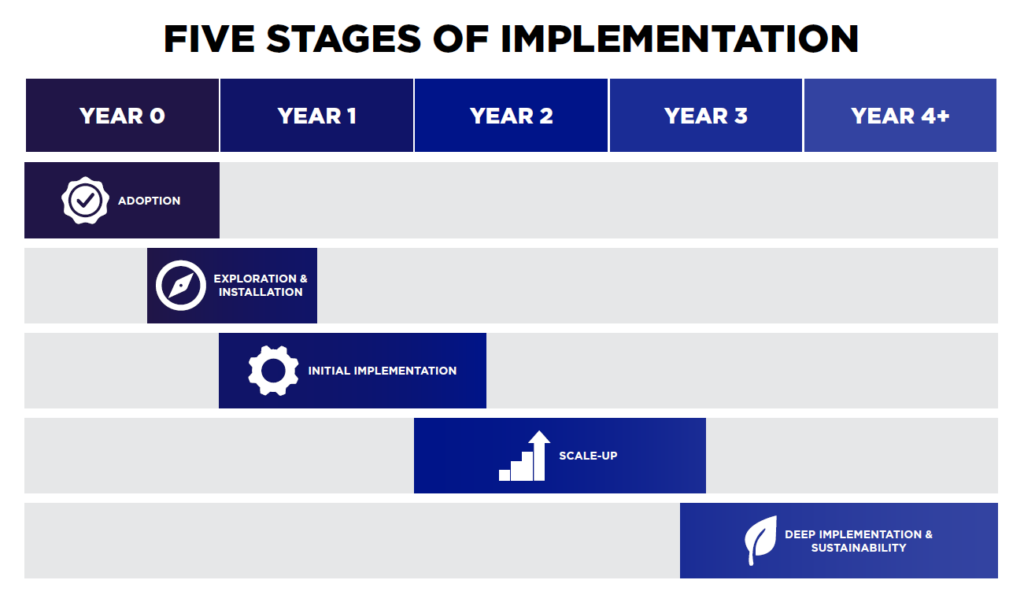

Adoption: Year 0
District, school, and teacher leaders engage in an established selection process to identify high-quality, standards-aligned materials that fulfill the district’s vision for excellent instruction and meet local needs and priorities.

Exploration & Installation: Year 1 & 2
District and school leaders assess readiness to implement by reviewing and adjusting systems and structures. During this stage, all teachers have access to the new materials, and time & activities focus on building understanding.

Initial Implementation: Year 2 & 3
Leaders establish and monitor expectations for usage and ensure high-quality, curriculum-based professional learning (CBPL) is provided; teachers focus on analyzing and using materials at a deeper level and as intended to support their implementation.

Scale-Up: Year 3 & 4
Leaders ensure materials are fully integrated into practices, routines, and local policies. In the scale-up stage, teachers skillfully use HQIM and student data begins showing improvement.

Deep Implementation & Sustainability: Year 3 & 4+
Leaders continue monitoring expectations for usage and provide ongoing CBPL; student data consistently shows improvement across all student groups.
Adapted from Rivet Education Instructional Materials Implementation Tool: A roadmap for high-quality instructional materials implementation (Rivet Education, 2024)
These resources are provided to guide leaders along the path of implementation and build their capacity to create and sustain the conditions for success with newly adopted materials.
Adaptive Challenges
- Aligning People, Time, and High-Quality Instructional Materials: A Path to Instructional Excellence (Rivet Education, 2025)
- The “case for curriculum” is about reducing teachers’ workload (Fordham Institute, 2024)
- Helping Teachers Find & Use High-Quality Materials, Including Science of Reading (by Eric Hirsch, EdReports | The 74, 2025)
- High-Quality Instructional Materials Implementation: Cultivating Buy-In, Confidence, and Collaboration (UnboundEd, 2025)
- A Holistic Examination of How Professional Learning and Curriculum Relate to Ambitious and Culturally Relevant Instruction and Student Engagement (Desimone et al., 2025)
- How Teachers Judge the Quality of Instructional Materials: Selecting Instructional Materials, Brief 1 – Quality (WestEd, 2017)
- Navigating HQIM Implementation at Scale: Insights From Rivet Education (The Center for Education Market Dynamics, 2024)
- The Path to High Quality Instruction: Aligning Instructional Vision, Teacher Support, and Instructional Materials (Carnegie Learning, 2025)
- Putting Adult Learning Models to Work (by Stephanie Hirsch & Chong-Hao Fu, Leading Educators, 2020)
- Teaching for Tomorrow: How Supporting Teachers Today Shapes Classrooms Tomorrow (Gallup | Walton Family Foundation, 2025)
- The Unrealized Promise of High-Quality Instructional Materials (by David Steiner, The Journal of the National Association of State Boards of Education, 2024)
- 3 Ways Instructional Leaders Can Support Teachers to Use High-Quality Materials (EdReports, 2022)
- What’s It Like To Be a Teacher in America Today? (Pew Research Center, 2024)
- Why Teachers Don’t Use the High-Quality Instructional Materials They’re Given (by David Steiner, The 74, 2024)
Instructional Leadership
- From the Classroom to Central Office: What I’ve Learned About Curriculum Adoption (by Jonathan Regino, EdReports, 2022)
- High-quality Curriculum Implementation: Connecting What to Teach with How to Teach It (National Institute for Excellence in Teaching, 2020)
- The Importance of Instructionally Focused Professional Learning (CCSSO, 2023)
- Leaders Play An Important Role In Implementing New Curriculum (The Learning Professional, 2024)
- Professional Learning is the Key to Improving Reading (Learning Forward | The Learning Professional, 2024)
- UnboundEd’s Approach to Building Leadership Capacity Through Curriculum Implementation (Unbound Ed, 2025)
Case Studies
- Building With High-Quality Instructional Materials (TNTP, 2024)
- Case Study: HQIM, It’s More Than Just Materials (ANet, 2025)
- Curriculum Resources | How to Implement High-Quality Instructional Materials (CurriculumHQ)
- Successful Implementation of High-Quality Instructional Materials: 5 Case Studies – PDF Version (Center for American Progress, 2019)
- Supporting Implementation With High-Quality Instructional Materials and Professional Learning: A Perspective From Louisiana (National Science Teaching Association, 2022)
Curriculum-Based Professional Learning
- A Conversation with Joslyn Richardson on Supporting High-Quality Instructional Materials and Professional Learning (National Implementation Research Network, 2024)
- The Art and Science of Curriculum-based Professional Learning (Learning Forward, 2024)
- Curriculum-based Professional Learning (Learning Forward, 2024)
- Curriculum-Based Professional Learning (Rivet Education)
- Curriculum-Based Professional Learning Shows Great Promise (Chu, McCarty, & Gurny, 2022)
- Curriculum-Based Professional Learning: The State of the Field (Center for Public Research & Leadership, 2022)
- Defining Curriculum-Based Professional Learning: Building a Common Language (Research Partnership for Professional Learning, 2025)
- The Elements: Transforming Teaching through Curriculum-Based Professional Learning (Carnegie Corporation of New York, 2020)
- For maximum impact, align professional learning with high-quality instructional materials (Fordham Institute, 2021)
- From Challenge Report to the Real World: How The Elements Can Spell Success for Educators (Carnegie Corporation of New York, 2021)
- High-quality curricula and team-based professional learning: A perfect partnership for equity (Learning Forward, 2018)
- How Curriculum-Based Professional Learning Can Boost Student Outcomes (Carnegie Corporation of New York, 2021)
- Professional Learning Diagnostic (Rivet Education, 2025)
- Professional Learning: The Key That Unlocks Knowledge for Teachers and Their Students (Great Minds, 2022)
- Professional Learning Partner Guide Provider Database (Rivet Education, 2020)
- Quality Instructional Materials Require Quality Professional Development (Carnegie Corporation of New York, 2020)
- Scaling Curriculum Based Professional Learning: Research & Learning Plan (Scaling Learning & RTI International, 2025)
- Spotlight on Oldham County: Aligning Professional Learning with High-Quality Instructional Resources (Kentucky Department of Education, 2025)
- Standards For Professional Learning (Learning Forward, 2022)
- Supercharge Your Curriculum-Based Professional Learning Strategy (Leading Educators, 2022)
- The Supply and Demand of Curriculum-Based Professional Learning (Rivet Education, 2024)
- Teachers’ professional learning should be driven by curriculum (Fordham Institute, 2020)
Multilingual Learners
- Resources | Understanding Language (Stanford Graduate School of Education | Center to Support Excellence in Teaching, 2017)
- Putting Multilingual Students at the Center of Curriculum-Based Professional Learning (Learning Professional, 2024)
- The 3 “Must-Haves” for High-Quality Math Materials: Mapping, Monitoring, and Making Connections (English Learners Success Forum, 2025)
Stages of Implementation
- Aligning People, Time, and High-Quality Instructional Materials: A Path to Instructional Excellence (Rivet Education, 2025)
- Beyond Selection: Rethinking How Districts Adopt Curriculum (EdReports & The Decision Lab, 2025)
- Brown Bag: The Instructional Materials and Professional Development (IMPD) Network – Our Next Phase of Work: SEAs Supporting Districts in Skillful Implementation of High-Quality Instructional Materials (HQIM) (Research Partnership for Professional Learning, 2023)
- Curriculum Implementation Change Framework (Center for Public Research & Leadership)
- Curriculum Implementation Guide (Chiefs for Change, 2019)
- Curriculum Implementation Project Planning Tool (Pivot Learning)
- Guide to the Implementation of High-Quality Instructional Materials (HQIM) (Comprehensive Center Network)
- High-Quality Curriculum Implementation Connecting What to Teach with How to Teach It (National Institute for Excellence in Teaching, 2020)
- Instructional Materials Implementation Tool: A roadmap for HQIM implementation (Rivet Education. 2024)
- Nebraska Content Area Standards Implementation Framework
- The Path to High Quality Instruction: Aligning Instructional Vision, Teacher Support, and Instructional Materials (Carnegie Learning, 2025)
- Phases of High-Quality Materials: ELA Implementation (Tennessee Department of Education)
- Q&A: Best Practices for Successful Curriculum Implementation (Instruction Partners, 2024)
- Taking curriculum implementation seriously (Fordham Institute, 2024)
- Using the RFP Process to Drive High-Quality Curriculum: Findings from the Field (Johns Hopkins School of Education – Institute for Education Policy, 2018).
- What are HQIM in Education? Why High-Quality Instructional Materials Matter More Than Ever (ANet, 2025)